
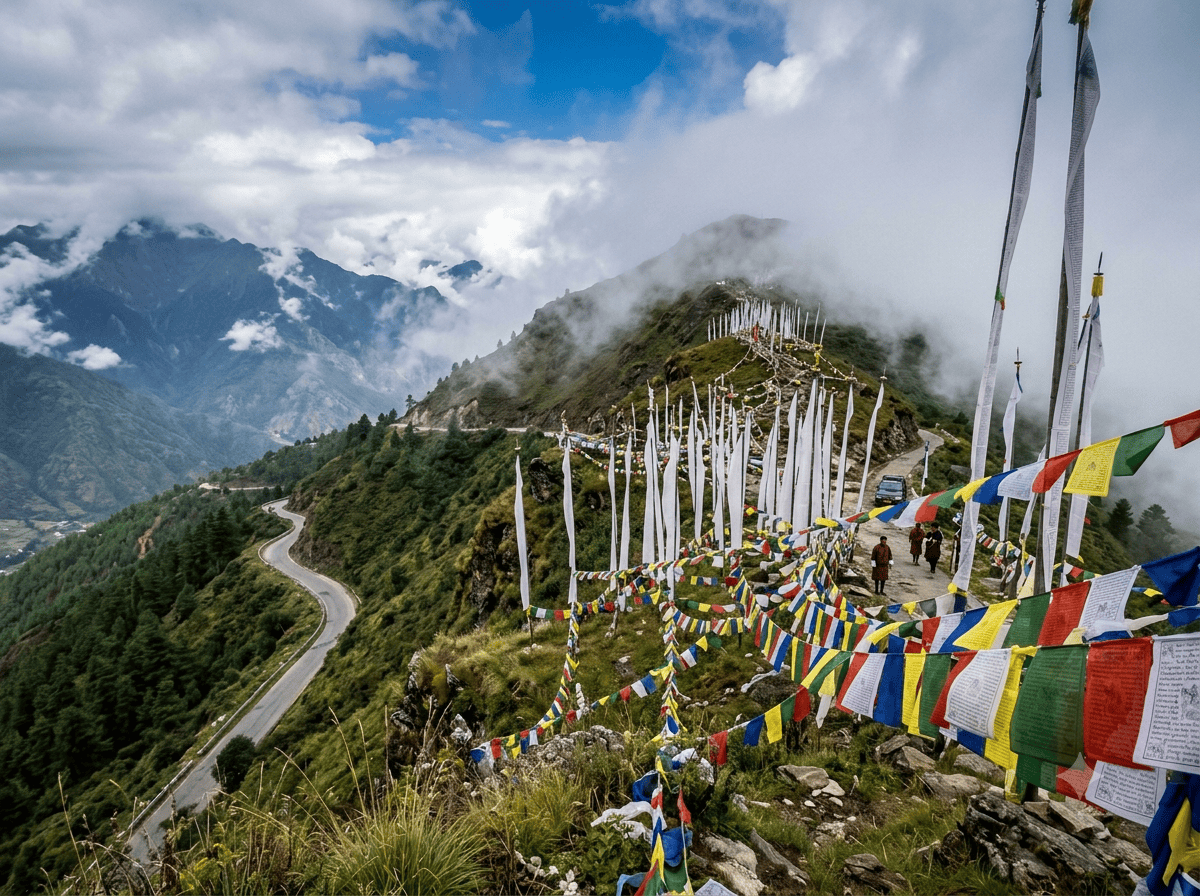
Looking for the best places to visit in Bhutan? This small Himalayan kingdom is compact enough that two weeks can cover most of its highlights, yet varied enough that no two valleys feel alike. One morning you’re looking at a monastery stuck to a cliff. By afternoon you’re driving over a prayer-flag-covered pass into a quiet farming valley. Hardly anything is far from anything else.
If you’re sketching out a route, these are the best places to visit in Bhutan, the ones most itineraries are built around.
1. Paro: Where Your Bhutan Story Begins
Many trips start here, since Paro has the country’s only international airport. The landing alone is memorable, with the plane threading between mountains into a green valley. (Our group trip enters Bhutan by road through Phuentsholing instead and reaches Paro later in the journey.)
The town is small and easy to walk. Rinpung Dzong watches over the valley, and the weekend market is worth a wander. Just outside town, you’ll also find the iron-chain bridge at Tachog Lhakhang, strung with prayer flags over a rushing river, one of those quiet spots people often miss.

2. Tiger’s Nest (Paro Taktsang): Bhutan’s Most Iconic Sight
If Bhutan has a postcard, this is it. Paro Taktsang, better known as Tiger’s Nest, clings to a granite cliff nearly 900 meters above the valley floor. The hike takes a few hours and is moderate, with some steep stretches, but the first clear view of the monastery makes the effort worthwhile.
Tip: Start early. The trail is cooler and quieter in the morning, and the light on the cliff is lovely.

3. Thimphu: A Capital Unlike Any Other
Thimphu is famous for having no traffic lights. At its busiest junction, a white-gloved officer directs traffic by hand.
Trashi Chho Dzong, the seat of Bhutan’s government and religious authority, is especially striking in late-afternoon light. Nearby you’ll find the National Memorial Chorten, where locals circle the stupa all day, and the huge bronze Buddha Dordenma looking out over the valley. Thimphu is also a good place to see how modern Bhutan sits alongside its traditions, from local markets to contemporary art spaces.

4. Where Two Rivers Meet: Punakha, One of the Best Places to Visit in Bhutan
Once Bhutan’s capital, Punakha is still one of the country’s most striking valleys, and many travelers find it the most beautiful of all. The dzong sits where two rivers meet, and it’s widely considered the finest in Bhutan, especially when the jacarandas bloom in late spring.
The valley is lower and warmer than Thimphu or Paro, so it’s a good stop even in winter. If you have extra time, walk across the suspension bridge near the dzong or try rafting on the Mo Chhu river.

5. Dochula Pass: Mountain Views and 108 Chortens
On the road between Thimphu and Punakha, Dochula Pass sits above 3,000 meters. When the sky is clear, you get one of the best Himalayan panoramas in Bhutan. Besides the views, the pass is marked by 108 memorial chortens built to honor Bhutanese soldiers, and a small café makes it an easy stop rather than a detour.
Tip: Clouds often roll in by mid-morning, so leave early for the best chance of clear views.

6. Phobjikha Valley and Gangtey: Slow Down and Breathe
This wide, glacial valley is the winter home of the endangered black-necked crane, which migrates here from the Tibetan plateau. Overlooking it is Gangtey Monastery, one of the most important Nyingma monasteries in Bhutan.
With no major town or dzong to draw crowds, Phobjikha feels quieter and more rural than Paro or Thimphu. It’s a good place to slow down, with easy nature walks through marshland, farmland, and forest trails around Gangtey village. The black-necked cranes arrive from late autumn, so winter is the best time to see them. On our 7N/8D group trip, Phobjikha is a day excursion from Punakha, with a visit to Gangtey Monastery.

7. Trongsa: The Dzong on the Ridge
Trongsa sits roughly at the geographic center of Bhutan, and Trongsa Dzong is one of the largest and most dramatic in the country, built along a ridge above a deep gorge. Historically, whoever controlled Trongsa controlled the country, and the town is still closely tied to the royal family.
Most people stop here on the way to or from Bumthang. However, the dzong alone makes the detour worthwhile.

8. Bumthang: The Spiritual Heartland
Bumthang is really four valleys, and it holds some of Bhutan’s oldest temples and monasteries, including Jambay Lhakhang and Kurjey Lhakhang. Apple orchards, honey, and locally brewed drinks add to its charm, so the region feels a little different from the rest of the country.
Because it’s further from Paro than Punakha or Phobjikha, Bumthang fits best into longer itineraries.

9. Haa Valley: Bhutan Off the Beaten Path
Haa was only opened to tourism in the early 2000s, and it’s one of the least visited valleys in the country. Pine forests, two prominent peaks and several ancient temples give the valley a more untouched feel than Paro or Thimphu. Every summer, the Haa Summer Festival celebrates local food, textiles and rural life.
As a result, Haa works well as a quieter add-on if you’ve already seen the more popular sights.

10. Chele La Pass: Prayer Flags at the Top
Above Paro, Chele La is one of the highest motorable passes in Bhutan. From the top, you get views over both the Paro and Haa valleys, and on a clear day you may catch Mount Jomolhari. Prayer flags stretch along the ridge, while in spring the short walks here are lined with rhododendrons. Most travelers visit as a half-day trip from Paro.

How to Plan Your Trip to the Top Places to Visit in Bhutan
Most Bhutan trips follow a familiar shape: Paro, Thimphu and Punakha, with the quiet Phobjikha Valley added if time allows. Together, that western circuit holds many of the top places to visit in Bhutan, and it fits comfortably into one week.
Our 7 Nights 8 Days Bhutan Group Trip with Phobjikha Valley follows exactly this route. It starts from Bagdogra Airport and enters Bhutan by road through Phuentsholing.
| Day | Plan |
|---|---|
| Day 1 | Bagdogra to Phuentsholing, then cross the Indo-Bhutan border on foot |
| Day 2 | Drive to Thimphu via the Dharma Kaya Stupa and Chuzom Bridge. |
| Day 3 | Thimphu sightseeing: Buddha Dordenma, National Memorial Chorten, Royal Takin Preserve. Then on to Punakha |
| Day 4 | Day trip to Phobjikha Valley and Gangtey Monastery, returning to Punakha |
| Day 5 | Punakha Dzong and suspension bridge, then over Dochula Pass to Paro |
| Day 6 | Tiger’s Nest hike, followed by a hot stone bath in the countryside |
| Day 7 | Rinpung Dzong in Paro, then drive back to Phuentsholing. |
| Day 8 | Return to Bagdogra Airport. |
This route covers Paro, Tiger’s Nest, Thimphu, Punakha, Dochula Pass and Phobjikha. However, Bumthang, Trongsa, Haa Valley and Chele La Pass are not part of the group trip. Because they involve longer mountain drives, they suit a longer or private itinerary better.
Your Sustainable Development Fee (SDF) and visa cost are included in the tour price. Spring and autumn are the most scenic seasons for passes and valleys, while the rainy summer months are less ideal. If you want the details, read our guide to the best time to visit Bhutan. If you want the details, read our guide to the best time to visit Bhutan.
Black-necked cranes arrive in Phobjikha from late autumn through winter. If seeing them matters to you, choose a November or December departure.
Ready to Plan Your Trip?
See our 7 Nights 8 Days Bhutan Group Trip with Phobjikha Valley, starting from ₹36,900 per person with confirmed departures. You can also browse all our Bhutan tour packages.
FAQs About the Places to Visit in Bhutan
What are the top places to visit in Bhutan?
Paro, Thimphu, Punakha, and Phobjikha Valley are the most visited. Together they give you the classic mix of monasteries, dzongs, and mountain scenery.
How many days do I need to see Bhutan?
Seven nights and eight days covers Paro, Thimphu and Punakha, plus a day trip to Phobjikha, including the Tiger’s Nest hike. Bumthang and Trongsa need extra days because of the long drives.
Is the Tiger’s Nest hike difficult?
It’s a moderate hike of about 3 to 5 hours, with some steep stretches. If you have an average level of fitness, you can do it, and horses are available at the starting point if you’d like a lift part of the way.
Which is better to visit, Bumthang or Haa Valley?
Bumthang has more historic temples and a deeper cultural experience, while Haa is quieter and closer to Paro. Both need extra days beyond a standard one-week trip.
Do I need a lot of time to see Punakha Dzong?
No, half a day is usually enough, and it combines easily with the suspension bridge walk and a stop at Dochula Pass.
Is the Sustainable Development Fee included in your Bhutan tour?
Yes. The SDF and visa costs are included in the price of our group tours.


Leave a Reply